5 Reasons Suppliers Fail to Deliver Large Contracts
Winning a major contract is one thing. Delivering on it is another. Most supplier failures on large contracts are not about competence — they are about structure, capital, and preparation.

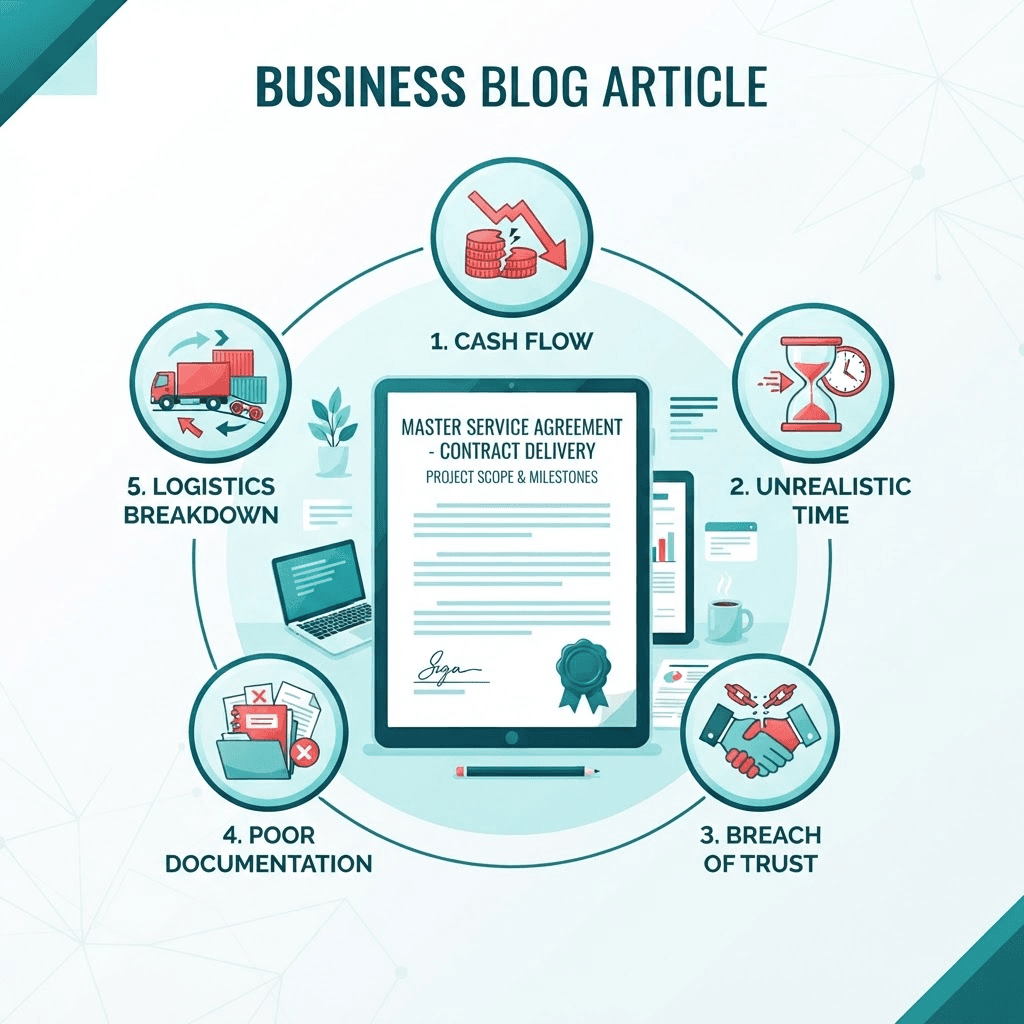
A construction materials supplier in Port Harcourt wins a ₦120 million tender to supply cement, rebar, and fittings to a real estate developer. It is a milestone for the business. Six weeks into the contract, delivery is behind, the funder is nervous, the buyer is sending warning emails, and the relationship that took two years to build is unravelling. What went wrong?
In most cases, the answer is not that the supplier was not capable. It is that they were not ready. Large contracts expose weaknesses in systems, capital, and structure that smaller orders never stress-test. These are the five patterns that appear most consistently when suppliers fail to deliver.
1. Undercapitalised execution
The most common failure point is running out of working capital mid-execution. A supplier wins a large order, secures partial payment or a mobilisation fee, and begins work — only to find that costs are higher than anticipated, a payment tranche is delayed by the buyer, or an unexpected expense drains the reserves they were counting on.
Without a capital buffer or access to transaction-based financing, any disruption to the cash flow becomes a delivery problem. The goods stop moving. The deadline starts slipping. The buyer loses confidence.
2. Underestimating the true cost of fulfilment
Margins that look good at quoting stage often look very different when execution begins. Prices for raw materials shift. Logistics costs are higher than budgeted. Quality issues require rework. The business priced to win the contract rather than priced to deliver it profitably.
Experienced suppliers build in contingency at the quoting stage — typically 10–15% above their base cost estimate. Newer suppliers learning on a large contract for the first time often do not.
3. Weak documentation and unclear terms
Disputes about scope, delivery specifications, payment milestones, and quality standards are among the most destructive forces in a large contract. They consume management attention, delay payments, and damage relationships. Most of them trace back to a contract that was not specific enough at the start.
- What exactly is being delivered — specifications, quantities, quality standards?
- What are the exact delivery dates and milestones?
- When does each payment fall due, and what triggers it?
- What happens if there is a delay — on either side?
- Who has authority to approve delivery and sign off payment?
A purchase order or contract that cannot answer all five of these questions in writing is a contract waiting to become a dispute.
4. Operational capacity that does not match the order size
Some suppliers win contracts their operations are not built to handle. They have the relationships and the credibility to win — but their warehouse capacity, logistics network, production throughput, or supplier relationships cannot scale to deliver at the volume and speed required.
This is particularly common among businesses that have grown quickly on smaller orders and land a transformative contract before their operations have caught up. Ambition outpaces infrastructure, and the contract becomes a crisis management exercise.
Large contracts expose weaknesses in systems, capital, and structure that smaller orders never stress-test.
5. Buyer payment delays that cascade into delivery failure
Sometimes the failure is not the supplier's fault — at least not directly. A buyer delays a payment milestone. The supplier, who was counting on that payment to fund the next delivery phase, cannot proceed. They are not unwilling to deliver; they literally cannot fund the next step without the cash that was supposed to flow in.
This is where controlled payment structures matter. When payments flow through managed channels with agreed milestones and escrow-like controls, both parties know what to expect and when. Delays become visible and manageable rather than invisible and catastrophic.
Key Takeaways
- Most large-contract failures are structural, not competence-related.
- Working capital gaps are the most common single point of failure.
- Underpricing fulfilment costs is a close second — always build in contingency.
- Ambiguous contract terms create disputes that stall payment and damage relationships.
- Controlled payment flows protect suppliers from buyer-side delays cascading into delivery failure.
Frequently Asked Questions
How do I assess whether my business can handle a large contract? Work backwards from the delivery requirements. What cash do you need at week one, week three, week six? What operational capacity do you need — staff, storage, logistics? Where are the gaps between what you have and what you need?
Should I walk away from a contract that seems too big? Not necessarily. The question is whether the gaps are fundable. A capital gap can often be bridged with transaction-based financing. An operational gap may require a partnership or phased delivery approach. Walk away only when the gap is structural and unfixable in the time available.
How should payment terms be structured on a large contract? Wherever possible, tie payments to delivery milestones rather than fixed dates. This aligns cash inflows with your execution stages and reduces the risk of a delayed payment stranding your capital mid-delivery.
Preparing to take on your next large contract?
Reelaay helps suppliers structure large transactions with the right working capital, buyer verification, and payment controls in place before execution begins. Speak to our team to walk through your next deal.
Omotayo Olowofeso
Founder & CEO, Reelaay
Omotayo Olowofeso is the Founder and CEO of Reelaay, where he is building the transaction platform that helps African suppliers execute confirmed purchase orders with working capital, verification, and settlement built in. He writes about B2B trade, working capital, and the operational realities of doing business across African markets.
View all articles