The Hidden Cost of Slow Payments in African Supply Chains
Late payments are not just an inconvenience. Across African supply chains, they compound into missed opportunities, damaged relationships, and stunted growth. The true cost is far greater than it appears.

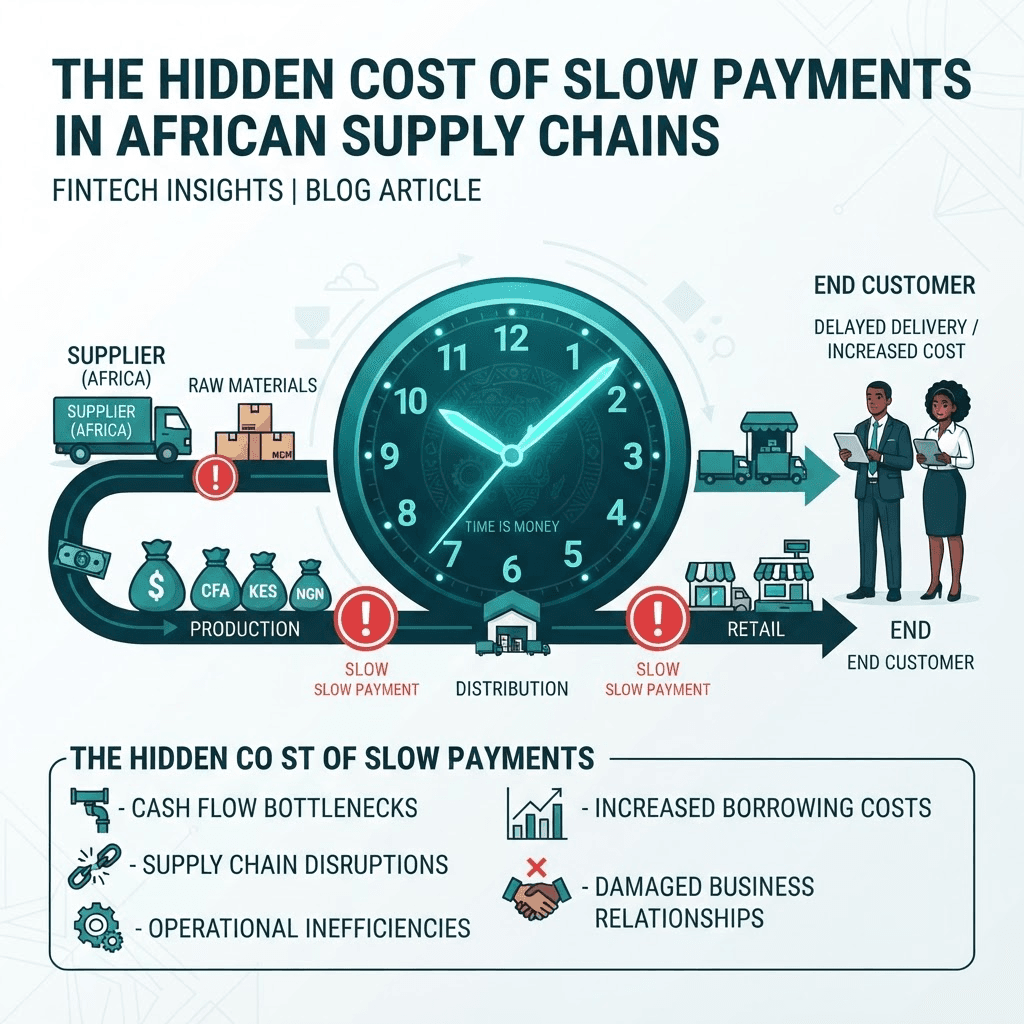
A fast-moving consumer goods distributor in Lagos delivers ₦40 million worth of goods to a retail chain in January. The agreed payment terms are net-45. By mid-March, the payment has not arrived. Calls are made, promises are given, excuses are offered. The money finally clears in early April — 75 days after delivery. The distributor has, in effect, lent the retail chain ₦40 million for three months at zero interest. But the cost goes much deeper than that.
What slow payments actually cost
The most obvious cost is the lost use of that capital. Money locked in a late receivable is money that cannot be deployed. But the cascade effect is where the real damage accumulates.
- Opportunity cost: the next order you could not fund because the capital was trapped.
- Borrowing cost: the expensive short-term credit you had to take on to cover operations while waiting for payment.
- Supplier cost: paying your own suppliers late because your receivables have not cleared, damaging your own supply relationships.
- Management cost: the hours — sometimes days — spent chasing payments instead of building the business.
- Relationship cost: the quiet erosion of trust when payment is repeatedly late, making both parties more cautious and less willing to do bigger deals.
Add these costs together over a year, and for many Nigerian distributors and manufacturers the actual drag from late payments is far greater than their financing costs, their logistics costs, or any other single operational expense.
Why it is worse in Africa than elsewhere
Late payments are a global problem, but they are structurally more damaging across African supply chains for several reasons. Formal credit markets are less developed, which means suppliers have fewer financing options to bridge gaps. Supply chains are often longer and more fragmented, so a payment delay at one node cascades more severely through the chain. And the businesses most affected — SME distributors, small manufacturers, agricultural processors — operate with thinner cash buffers than their counterparts in more capital-deep markets.
The International Finance Corporation has estimated that the trade finance gap in Africa runs into hundreds of billions of dollars. Late payments are not the only contributor — but they are one of the most consistent and preventable ones.
For many distributors and manufacturers, the drag from late payments is far greater than their logistics or financing costs combined.
Who bears the cost
The cost of slow payments does not stay with the immediate parties. When a distributor is squeezed, they pay their own suppliers late. Those suppliers pay their employees late or reduce orders from their raw material providers. The delay ripples outward through the supply chain, weakening every link it touches.
Ultimately, slow payments slow down commerce. They reduce the velocity of trade and the number of transactions that can be executed in any given period. In an economy where SMEs account for a large proportion of employment and output, this is not a business problem. It is an economic problem.
What can be done
- Buyers should move toward milestone-based payments tied to confirmed delivery rather than fixed calendar dates.
- Suppliers should build payment terms and enforcement into contracts explicitly, not assume goodwill.
- Transaction platforms that confirm delivery and trigger payments automatically reduce the friction of enforcement.
- Working capital tools that bridge payment gaps allow suppliers to operate without being hostage to buyer behaviour.
- Supplier financing at the buyer level — where buyers arrange financing for their suppliers' receivables — is emerging as a structural solution in larger organisations.
Key Takeaways
- The cost of late payments extends far beyond the direct receivable — it includes opportunity cost, borrowing cost, and relationship damage.
- Slow payments cascade through supply chains, weakening every business they touch.
- African SMEs are disproportionately exposed because they have fewer financing options and thinner buffers.
- Structural solutions — controlled payment flows, milestone-based terms, and transaction platforms — reduce the frequency and impact of late payments.
- Solving the slow payment problem is not just good for individual businesses. It is good for supply chain health overall.
Frequently Asked Questions
Is there a legal remedy for late payments in Nigeria? Yes. The Companies and Allied Matters Act and standard commercial contracts provide remedies. However, enforcement is costly and slow, which is why structural prevention — clear terms, milestone payments, escrow-like controls — is more practical than litigation.
Can technology help prevent late payments? Significantly. Transaction platforms that trigger payments upon confirmed delivery, send automated reminders, and maintain a clear audit trail of what was agreed reduce late payments by removing ambiguity and inertia from the process.
What is early payment financing? Some large buyers offer to pay suppliers earlier than the agreed terms in exchange for a small discount on the invoice. This is called dynamic discounting or supply chain finance. It benefits both sides: the supplier gets cash faster, and the buyer earns a return on surplus cash.
Want faster, more predictable payments on your orders?
Reelaay structures transactions with controlled payment flows and clear settlement timelines built in. If slow payments are limiting your business, talk to our team about how the platform works.
Omotayo Olowofeso
Founder & CEO, Reelaay
Omotayo Olowofeso is the Founder and CEO of Reelaay, where he is building the transaction platform that helps African suppliers execute confirmed purchase orders with working capital, verification, and settlement built in. He writes about B2B trade, working capital, and the operational realities of doing business across African markets.
View all articles