Purchase Order Financing Explained in Plain English
The phrase gets thrown around a lot. But what does purchase order financing actually mean, how does it work step by step, and who is it really for? Here is the plain-language answer.

A textile manufacturer in Kano wins a government supply contract for school uniforms — 10,000 pieces, confirmed, with a delivery deadline in eight weeks. The contract is worth ₦35 million. The problem: buying the fabric, thread, and materials, plus paying for the production run, will cost ₦28 million. That money does not exist in the business right now. This is the gap that purchase order financing is designed to close.
What purchase order financing is — in plain terms
Purchase order financing, often called PO financing or PO funding, is a form of working capital that is advanced to a supplier against a confirmed, verified purchase order. You do not borrow against your property, your business history, or a generic credit score. You borrow against a real order, from a real buyer, for a defined amount, with a defined timeline.
The result is that the transaction itself — rather than your existing assets — becomes the basis for the capital. This changes who can access financing. It shifts the question from 'what do you own?' to 'what have you been asked to deliver, and by whom?'
How it works, step by step
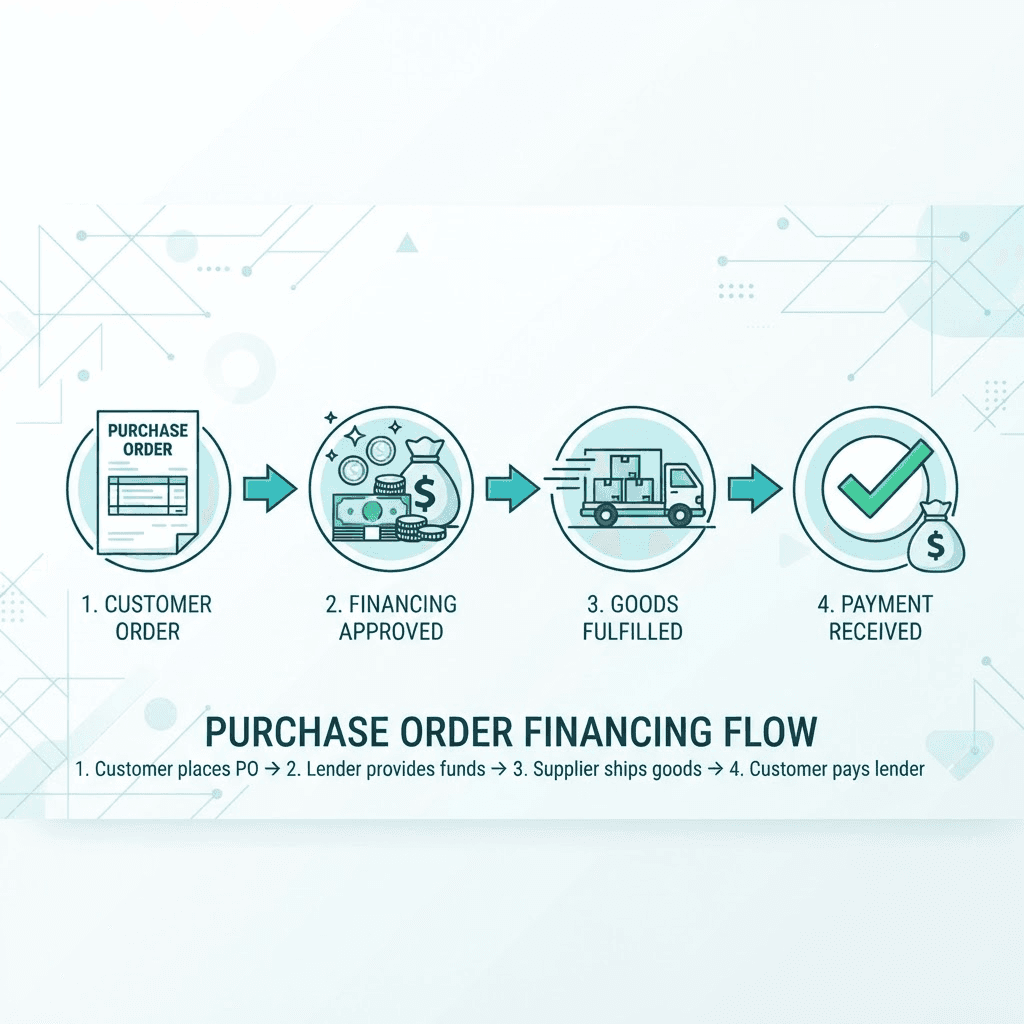
- You receive a confirmed purchase order from a credible buyer.
- You submit the order, buyer details, and your fulfilment plan for review.
- The buyer is verified and the transaction is assessed.
- Working capital is advanced — typically a percentage of the order value — to help you procure goods or begin production.
- You fulfil the order and deliver to the buyer.
- The buyer pays. The financing is settled, and your margin is released to you.
The entire cycle is tied to one transaction. Once that transaction is settled, the financing closes. This is very different from a bank overdraft or a general business loan, which have no connection to the underlying work being done.
Who uses PO financing
PO financing is commonly used by distributors, manufacturers, wholesalers, and enterprise suppliers who deal in large orders and face regular gaps between execution costs and buyer payment. Industries that rely heavily on it include FMCG, healthcare supply, construction materials, agricultural commodities, and government procurement.
It is especially well-suited to businesses that are operationally strong but asset-light — businesses that are good at what they do but do not own the kind of physical assets that traditional lenders want as security.
It shifts the question from 'what do you own?' to 'what have you been asked to deliver, and by whom?'
The difference between PO financing and an invoice loan
These two are often confused. Invoice financing (or factoring) gives you capital against an invoice you have already issued — meaning you have already delivered. PO financing gives you capital before delivery, against the confirmed order. PO financing is an earlier intervention. It solves the problem of funding the work, not just recovering from having already done it.
What makes a PO financeable
- The purchase order is in writing, signed or formally confirmed by the buyer.
- The buyer is a credible, verifiable business or institution.
- The order amount and delivery terms are clearly defined.
- The supplier has a realistic plan to fulfil and deliver.
- The gross margin on the order is sufficient to cover the cost of financing.
Not every order will qualify, and that is intentional. PO financing is only useful when the underlying transaction is sound. That is what protects the supplier as much as the funder.
Key Takeaways
- PO financing gives you working capital before delivery, tied to a specific confirmed order.
- It is based on the strength of the transaction and the buyer — not your asset base.
- It is different from invoice financing, which comes after goods are delivered.
- It is most useful for distributors, manufacturers, and suppliers dealing in large, confirmed B2B orders.
- The quality of the purchase order and buyer matters — verification is essential.
Frequently Asked Questions
Is PO financing the same as a loan? It shares features with a short-term loan but is structured differently. It is tied to a specific transaction, typically has no fixed monthly repayment, and is settled when the buyer pays — not on a fixed schedule.
Can startups or early-stage businesses use PO financing? Yes, in many cases. Because approval is based partly on the buyer's creditworthiness, younger businesses with strong buyers can qualify where they would not for traditional lending.
What percentage of the order value can be financed? This varies by platform and transaction. Typically, the financing covers the cost of goods or production — the execution cost — rather than the full invoice amount.
Want to learn if your next order qualifies?
Reelaay reviews confirmed purchase orders from Nigerian and African suppliers and provides working capital, buyer verification, and payment control in a single platform. Reach out to our team to walk through your next transaction.
Omotayo Olowofeso
Founder & CEO, Reelaay
Omotayo Olowofeso is the Founder and CEO of Reelaay, where he is building the transaction platform that helps African suppliers execute confirmed purchase orders with working capital, verification, and settlement built in. He writes about B2B trade, working capital, and the operational realities of doing business across African markets.
View all articles