Working Capital vs Profit: Why Growing Businesses Still Run Out of Cash
Your P&L shows healthy margins. Your bank account tells a different story. Understanding the gap between profit and working capital is one of the most important things a growing business can do.

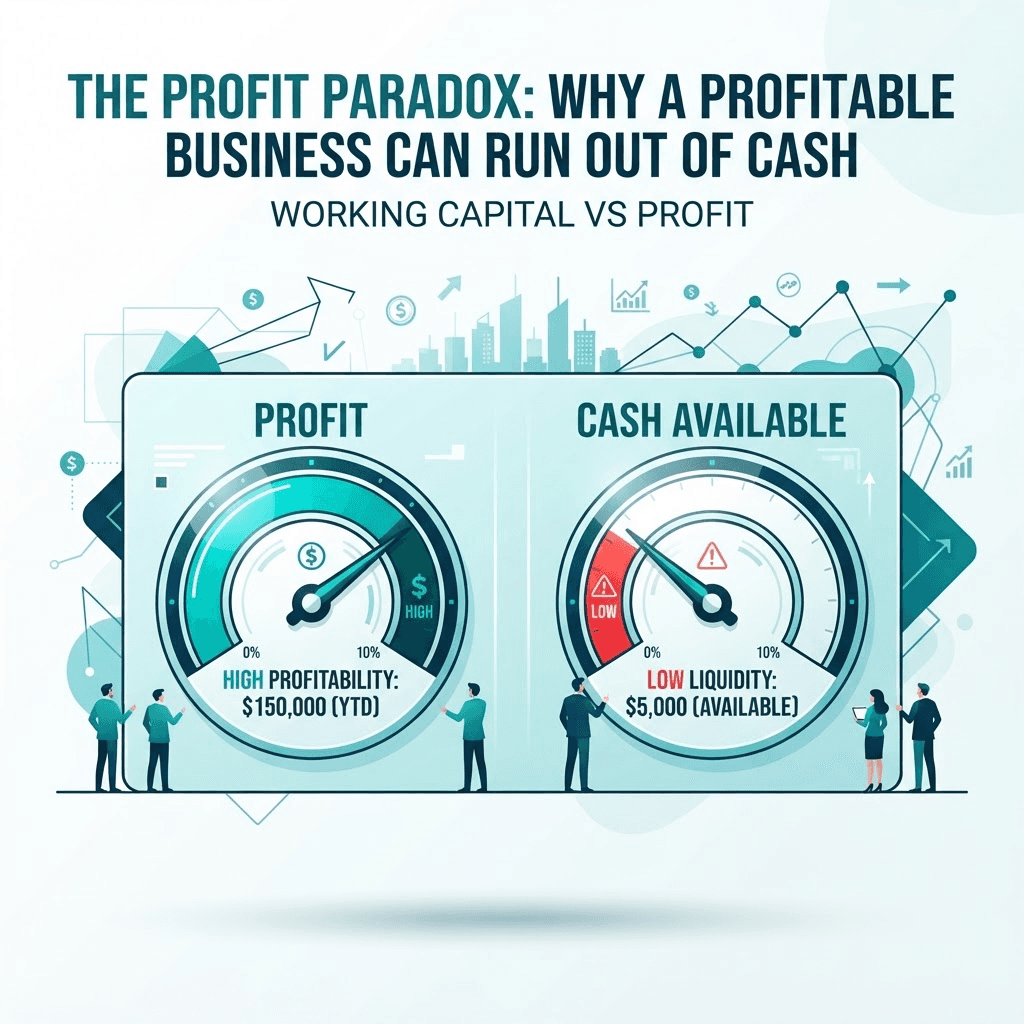
A Lagos-based pharmaceutical distributor finished the financial year with a profit of ₦18 million on revenue of ₦200 million. Their accountant was pleased. Their bank balance told a different story: less than ₦3 million available at any point during that year, with several weeks where payroll was genuinely at risk. The business was profitable. And it was permanently on the edge of a cash crisis.
This is one of the most misunderstood dynamics in business finance — and it catches smart, hardworking business owners by surprise more often than it should.
Profit is not cash
Profit is what remains on paper after you subtract costs from revenue. It is a accounting concept that records income when it is earned, not when it is received. Your profit and loss statement might show ₦18 million earned in a quarter, but if ₦15 million of that is sitting in unpaid invoices from buyers with 60-day payment terms, you cannot spend any of it. Not yet.
Working capital, by contrast, is what you can actually deploy. It is the money available to fund operations — buy stock, pay suppliers, cover salaries, handle logistics — right now. The formula is simple: current assets minus current liabilities. But the real-world experience of managing it is anything but simple.
Why growth makes it worse
Here is the counterintuitive truth: growing fast can make your cash position worse, not better. Every new large order requires you to commit cash before the revenue arrives. The bigger the order, the bigger that upfront commitment. And because payment terms are usually fixed by the buyer — 30, 60, 90 days — the gap between spending and receiving grows with the size of your business.
- You win a ₦80 million order. You spend ₦60 million to execute it.
- Delivery happens in week four. Payment arrives in week twelve.
- During weeks four to twelve, your ₦60 million is locked inside the transaction.
- If another order comes in during that period, you may not be able to fund it.
- Meanwhile, on paper, you are showing healthy revenue growth.
This is the growth trap. The faster you grow, the more working capital you consume relative to the profit you generate — until the structure catches up with the cash cycle.
The faster you grow, the more working capital you consume relative to the profit you generate.
The industries where this bites hardest
Some businesses are more vulnerable than others. The worst-affected are those that combine large order sizes, long buyer payment terms, and significant up-front execution costs. In Nigeria and across Africa, this describes a large proportion of the most productive sectors: agriculture, FMCG distribution, healthcare supply, construction materials, oil and gas services, and government procurement.
These are not struggling businesses. They are often the most commercially active, with the most confirmed orders. They are profitable on the financial statements. But their cash is almost always somewhere between 'deployed' and 'in transit.'
How to manage the gap
- Know your cash conversion cycle: how long between spending money and receiving it back.
- Forecast cash, not just profit — model what your bank balance will look like week by week.
- Negotiate payment terms with buyers where possible; even moving from net-60 to net-45 compounds positively over a year.
- Use transaction-based financing to bridge the gap on specific orders so your available cash is not the limiting factor.
- Track every receivable actively — money that is owed but not yet chased is capital you are lending for free.
The businesses that navigate this well are not the ones with the highest margins. They are the ones that understand working capital as a strategic resource — something to be planned, preserved, and deployed deliberately.
Key Takeaways
- Profit and working capital are fundamentally different things. A profitable business can run out of cash.
- Growth accelerates the working capital gap because execution costs are paid before revenue is received.
- The cash conversion cycle — time between spending and receiving — is the critical metric to manage.
- Industries with large orders and long payment terms are the most exposed.
- Transaction-based financing is one of the most effective tools for bridging the gap without compromising growth.
Frequently Asked Questions
What is working capital in simple terms? Working capital is the money available to run the business day to day. It is current assets (cash, receivables, inventory) minus current liabilities (money you owe in the short term). A positive working capital means you can fund operations. A negative working capital is a warning sign.
Is it possible to be profitable and insolvent? Yes. This is sometimes called a 'profit-and-loss solvent, cash-flow insolvent' situation. If you cannot pay your obligations when they fall due — even if your accounts show a profit — you are effectively insolvent in practice.
What should a healthy cash conversion cycle look like? This varies by industry, but the shorter the better. Businesses that collect from buyers quickly and pay suppliers flexibly are in the strongest positions. Most well-run SME distributors in Nigeria aim for a cycle of under 45 days.
Get a clearer picture of your working capital position
Reelaay helps suppliers understand and manage their transaction-level cash position. If you are dealing with large confirmed orders and struggling to fund execution, talk to our team about how working capital can be structured around your specific transactions.
Omotayo Olowofeso
Founder & CEO, Reelaay
Omotayo Olowofeso is the Founder and CEO of Reelaay, where he is building the transaction platform that helps African suppliers execute confirmed purchase orders with working capital, verification, and settlement built in. He writes about B2B trade, working capital, and the operational realities of doing business across African markets.
View all articles